
UK Tyre Labels Explained: What the Ratings Actually Mean
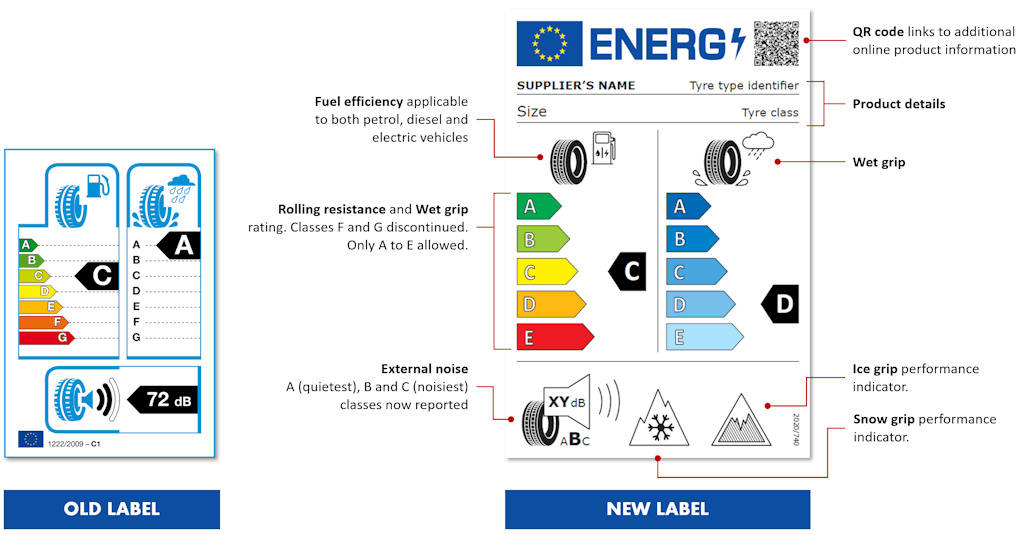
Every new car tyre sold in the UK comes with a label, and it is the quickest way to compare two tyres that otherwise look identical. It is also widely ignored — most people buy on brand and price alone.
Here is what the label actually tells you.
The label changed in 2021
The tyre label was redesigned under Regulation 2020/740, which applied in Great Britain from 1 May 2021. If you are comparing an older set of tyres against a new quote, you may still see both formats.
The two biggest changes:
- The F and G classes were scrapped. Fuel efficiency and wet grip are now rated A to E only. An old "C" and a new "C" are not directly comparable.
- A QR code was added, linking to the full product entry in the European Product Registry for Energy Labelling.
The new label also carries the supplier's name, a tyre type identifier, the size and tyre class, and — where relevant — ice grip and snow grip icons.
Fuel efficiency
The left-hand rating measures rolling resistance: how much energy the tyre wastes as it deforms and recovers with every rotation. Less waste means less fuel, and it applies to petrol, diesel and electric vehicles alike.
The difference between an A-rated and an E-rated tyre is real but modest — think a few percent on fuel consumption. On an EV it shows up as range rather than MPG.
Wet grip
The right-hand rating measures braking distance on a wet road. This is the rating we would tell you to prioritise.
Each class step represents roughly a car length of extra stopping distance from 50mph. Across the full A-to-E range that difference is substantial, and it is the one rating that matters at the exact moment you need it most.
External noise
The bottom section gives a measured noise figure in decibels alongside a class of A, B or C — A being the quietest.
This measures noise emitted outside the vehicle, for environmental purposes. It correlates loosely with cabin noise, but a quiet-rated tyre is not guaranteed to be a quiet tyre from the driver's seat.
Ice and snow grip
Two icons may appear on the new label:
- The three-peak mountain snowflake (3PMSF) marks a tyre certified for severe snow conditions.
- The ice grip icon marks a tyre tested for grip on ice, and is aimed at Nordic winter tyres.
Most drivers in Manchester will not need either, but they are worth knowing about if you regularly travel somewhere colder.
What the label does not tell you
The label covers three measured criteria. It says nothing about dry braking, handling, tread life, aquaplaning resistance or ride comfort — all of which vary enormously between tyres with identical labels.
Use the label to narrow a shortlist, then ask us. We fit these tyres every day and we will tell you honestly where the money is worth spending.
Not sure what size you need? Search by tyre size to see what we have in stock, or get in touch and we will talk it through.