
The 20p Test: Check Your Tyres in Two Minutes
Your tyres are the only part of your car that touches the road. Four contact patches, each roughly the size of your hand, doing all the steering, braking and accelerating.
TyreSafe, the UK tyre safety charity, boils the check down to three things — ACT: Air pressure, Condition, Tread.
T is for Tread — the 20p test
The legal minimum tread depth in the UK is 1.6mm, across the central three-quarters of the tyre's width, around its entire circumference.
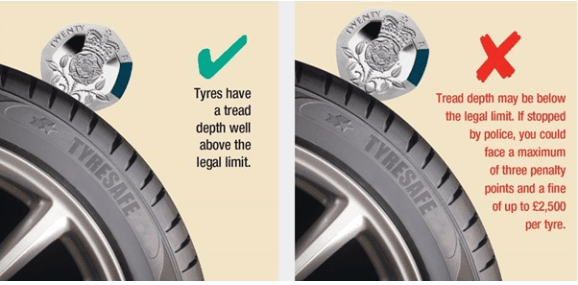
You do not need a gauge to get a good indication. You need 20p.
- Insert a 20p coin into the main tread grooves.
- If you cannot see the outer band of the coin, your tread is above the legal limit.
- If you can see the outer band, your tread may be below the legal limit and the tyre needs checking properly.
Do this at several points around each tyre and across its width. Tyres rarely wear evenly, and it is common for one edge to be legal while another is not.
The penalties are per tyre
Driving on an illegal tyre carries up to three penalty points and a fine of up to £2,500 — for each tyre. All four illegal means a potential £10,000 and twelve points, which is a ban.
It will also fail its MOT, and it may well invalidate your insurance after an accident.
Do not wait for 1.6mm
1.6mm is the point at which a tyre becomes illegal, not the point at which it stops performing. Wet braking distances lengthen considerably below around 3mm as the grooves lose the volume to clear water.
We would suggest planning replacement at 3mm and treating 2mm as urgent.
A is for Air pressure
Covered properly in our tyre pressure guide — check monthly, check cold, and use the figure from your handbook or door shut rather than the number on the sidewall.
C is for Condition
Walk around the car and look at each tyre properly:
- Cuts, cracks or bulges in the sidewall. A bulge means the internal structure has failed — that tyre needs replacing now, not soon.
- Objects in the tread. A nail may be plugging its own hole; pulling it out yourself can turn a repairable puncture into a new tyre.
- Uneven wear. Wear on one edge usually points to alignment or worn suspension components. Replacing the tyre without fixing the cause just wears out the new one.
- Age. Tyres harden over time regardless of tread. Check the four-digit DOT code on the sidewall —
2319means week 23 of 2019. Anything past about ten years is worth a professional look even if it appears fine.
When to bring it to us
If the 20p test is marginal, if you find a bulge or a cut, or if the wear pattern looks lopsided, bring it in. A proper depth gauge and a look at the whole tyre takes a couple of minutes and settles it either way.
We do not charge for checking.
Need replacements? Search by tyre size to see what we have in stock, or call us on 0161 945 3556.